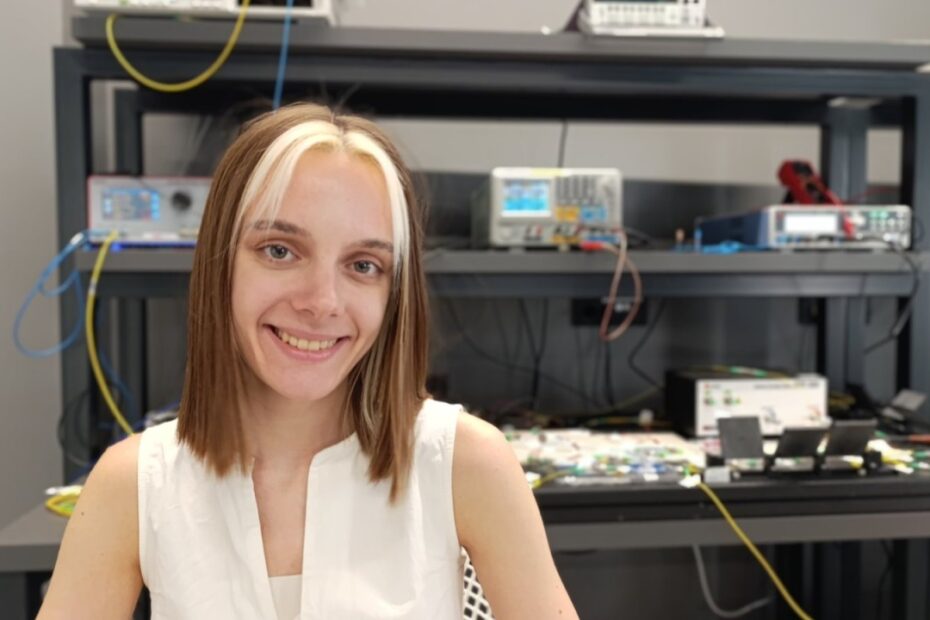
In our newest article, we highlight Kristina Jović, a graduate of Physical Electronics – Nanoelectronics and Photonics, who completed her experimental thesis within the Center for Neuromorphic Photonics at Palace of Science.
Her research dives into phase–intensity coupled bistability in Fabry–Pérot laser diodes – a phenomenon with major implications for future ultrafast, reconfigurable optical computing components.
Kristina is continuing her master’s studies at the Abbe School of Photonics, Friedrich Schiller University Jena, supported by the Abbe School of Photonics Scholarship.
Read her full story below 👇
About Kristina
Kristina studies Physical Electronics – Nanoelectronics and Photonics. Alongside her interest in light–matter interactions and optical technologies, she has a deep passion for painting, particularly miniature art. She enjoys capturing memories through intricate, detailed compositions – a hobby that reflects her precision, patience, and attentiveness. She also played volleyball growing up, which taught her teamwork and collaboration from an early age.
Thesis Title
Coupled phase–intensity bistability in Fabry–Pérot lasers under optical injection
Her research focused on exploring coupled bistability between optical phase and intensity in Fabry–Pérot laser diodes subjected to optical injection.
By tuning the frequency detuning in the range of −15 to −21 GHz (red-shifted from the central mode), Kristina investigated transitions between the free-running (FR) and injection-locked (IL) states.
Using a fiber-optic interferometer, she examined how the spectrally filtered master-laser power evolves across these transitions. The results show that increasing frequency detuning expands the regions of phase–intensity coupled bistability, enabling reconfigurable complex-valued responses with experimentally measured power ratios up to ~8 dB and phase jumps up to 0.9 rad.
These findings indicate that similar Kramers–Kronig-type coupling will also appear under pulsed injection – pointing toward the potential for reconfigurable, high-speed nonlinear activators based on complex values.
Q: What technical problem did you work on the most, and what did you learn during the process?
My biggest contribution was to the experiment related to my thesis, although I also worked on the optical reservoir computing setup and a wavelength converter experiment, supporting the diploma theses of my colleagues.
The work taught me what it truly means to operate in a scientific environment and how many unexpected challenges appear during experimental development. I gained hands-on experience with fibers, modulators, lasers, and other key components, and learned a lot about data processing, which turned out to be as challenging as the experimental setup itself.
Q: How did you apply theoretical knowledge to practical experiments?
Before starting the experiment, I had to understand the underlying theory — what we wanted to observe and how to measure it. We aimed to explore phase–intensity coupled hysteresis using fiber-optic interferometry and coherent detection.
The theory included many equations, but the experiment brought them to life. Seeing theoretical concepts manifest in real measurements was fascinating. Designing the setup required linking components in ways that matched the expected theoretical outcome.
Q: How did teamwork influence your communication and collaboration skills?
Teamwork teaches you that everyone works differently, at a different pace, with different approaches. Achieving a shared goal requires patience, mutual respect, and understanding.
Q: Can you describe a moment when you had to adapt quickly to unexpected experimental results?
A memorable moment was when we urgently needed exactly 24 cm of fiber to match both arms of the interferometer. The system is extremely sensitive, so even minimal mismatches affect the results. Luckily, we found exactly the needed length without splicing, and the whole team celebrated because proper matching was essential for the experiment. Without that fiber, the experiment would have been significantly delayed.
Q: Which personal trait helped you most during research challenges?
My determination and commitment. Once I decide to achieve something, I don’t stop until it’s done — even if that means long hours, little sleep, and lots of coffee.
Q: How important was the support of mentors and colleagues?
Crucial. Their enthusiasm kept us motivated, especially at times when the experiment felt impossible. Without their guidance and the support of my peers, we wouldn’t have achieved what we did.
Q: What sets you apart as a candidate for future employers?
During my studies, I already noticed that not everyone had the opportunity to work on such advanced experiments during their undergraduate years. Gaining this depth of knowledge early is a major advantage.
Q: How will the knowledge you gained here shape your further studies and career?
The skills I gained in the Center for Neuromorphic Photonics serve as an excellent foundation for many areas I hope to pursue. Even if my future direction diverges from neuromorphic photonics, there is always overlap within the broader field of photonics. I’m grateful to have both theoretical and practical knowledge in this area.
Q: What is the biggest advantage of working in this Center compared to standard university learning?
The dedication of the mentors. They were always available, always supportive, and created an atmosphere where no question felt “wrong.” The pace can seem fast at first, but it pays off in the end — and I’m glad everything was exactly as it was.
Q: What can students expect if they choose to do their final project in ORCA-Lab?
They can expect to gain knowledge they wouldn’t normally develop during undergraduate studies — along with guidance, dedication, and full support from mentors.
Q: Why should employers pay attention to students from this Center?
Because the level of hands-on experimental work and theoretical understanding we gain here is rare. It gives students a competitive edge compared to typical undergraduate graduates.
ext Step
Kristina is continuing her studies at the 🎓 Friedrich-Schiller University Jena – Abbe School of Photonics, supported by the Abbe School of Photonics Scholarship.