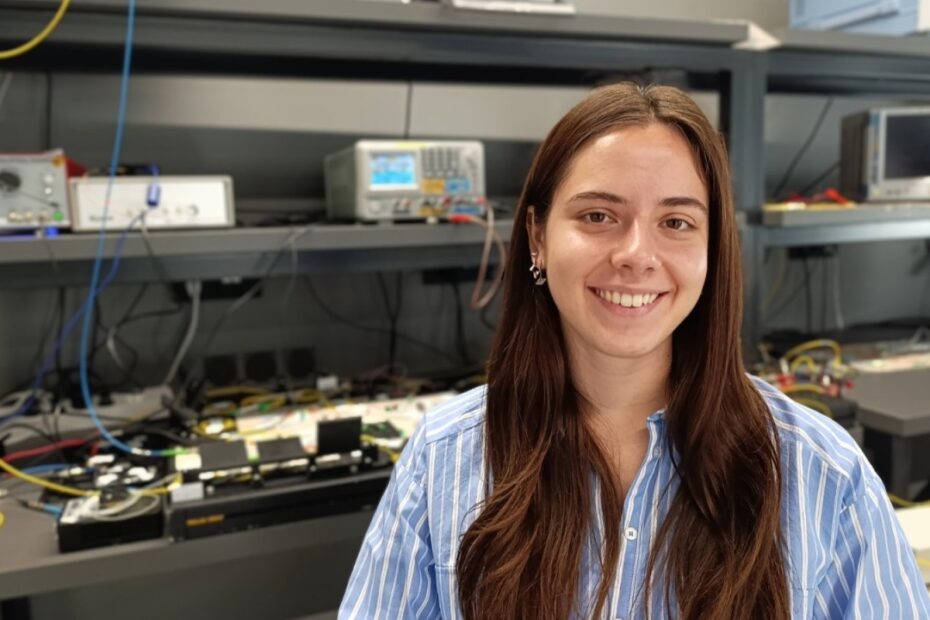
we proudly present Anđela Dakić, a student of Physical Electronics – Nanoelectronics and Photonics, who carried out her experimental diploma thesis within the Center for Neuromorphic Photonics in Palace of Science
Her research focused on developing a reconfigurable all-optical nonlinear activator based on a Fabry–Perot laser diode with multi-wavelength output -a key building block for the next generation of optical neural networks.
Anđela will continue her academic journey with the EU-funded Master QUARMEN program in Quantum Science and Technology, pursuing her passion for quantum optics, microscopy, and optical applications in medicine.
Read her inspiring story 👇
Anđela is a student of Physical Electronics – Nanoelectronics and Photonics. She describes herself as a cheerful and positive person passionate about science and experimental optics. Her main interests include quantum optics, microscopy, and the application of optical technologies in medicine. Outside the lab, she has been devoted to ballet for over 10 years, which she describes as her favorite hobby and source of discipline and creativity.
Research Focus
Her diploma thesis, titled “Reconfigurable all-optical nonlinear activator based on Fabry–Perot laser diode with multi-wavelength output capacity,” explores optical neural networks, an emerging technology with the potential for ultra-fast and energy-efficient information processing.
The work focused on dual injection into the Fabry–Perot laser resonator to obtain different nonlinear activation functions, a fundamental operation for neuromorphic computing. The results demonstrated that dual injection generates a broad spectrum of nonlinear responses and enables reconfigurability and multi-wavelength outputs – crucial steps toward scalable optical computing.
Q: What technical or software skills did you develop during your lab work, and how will they support your career?
I learned how to design, set up, and run experiments in photonics, and how to record and process the obtained data. This experience strengthened both my practical and analytical skills – essential for my future career in experimental optics.
Q: What technical problem challenged you the most, and what did you learn from solving it?
The most demanding task was data processing, which was quite complex. However, it taught me valuable lessons that will help me in analyzing any kind of experimental data in the future.
Q: How did you connect theoretical knowledge from your studies with practical experiments?
When setting up the experiment, I relied heavily on what I learned during my studies. Applying that knowledge in practice helped me clarify some uncertainties and deepen my understanding. It was rewarding to see how theoretical concepts transform into measurable phenomena.
Q: How did teamwork shape your communication and collaboration skills?
Working in a team taught me how collaborative projects differ from individual work. I learned how to share tasks, exchange ideas, and communicate effectively, skills that are essential in any research or professional environment.
Q: How did you handle unexpected experimental results?
During experiments, unexpected results happened often, even a small change in setup could significantly alter the outcome. It required patience and adaptability to understand the causes and adjust the experiment accordingly.
Q: What do you think sets you apart as a candidate for future employers after this experience?
Persistence and commitment — once I start working on something, I’m determined to see it through to the end.
Q: What do you see as the biggest advantage of working in the Center for Neuromorphic Photonics compared to traditional academic learning?
The biggest advantage is definitely the state-of-the-art laboratory equipment and the mentors who are eager to share their knowledge and support us at every step.
Q: What can students expect if they decide to do their final project in ORCA-Lab?
They can expect to learn a lot, gain invaluable research experience, and create great memories along the way.
Q: What message would you share with students who are considering joining the lab?
They absolutely should! You’ll gain knowledge, experience, and, most importantly, you’ll enjoy working in such a supportive and inspiring environment.
Next Step
Anđela will continue her studies within the EU-funded QUARMEN Master’s program in Quantum Science and Technology, focusing on the intersection of photonics and quantum research. Her journey reflects the mission of our Center: To empower young researchers to combine creativity, curiosity, and scientific rigor to shape the technologies of the future.